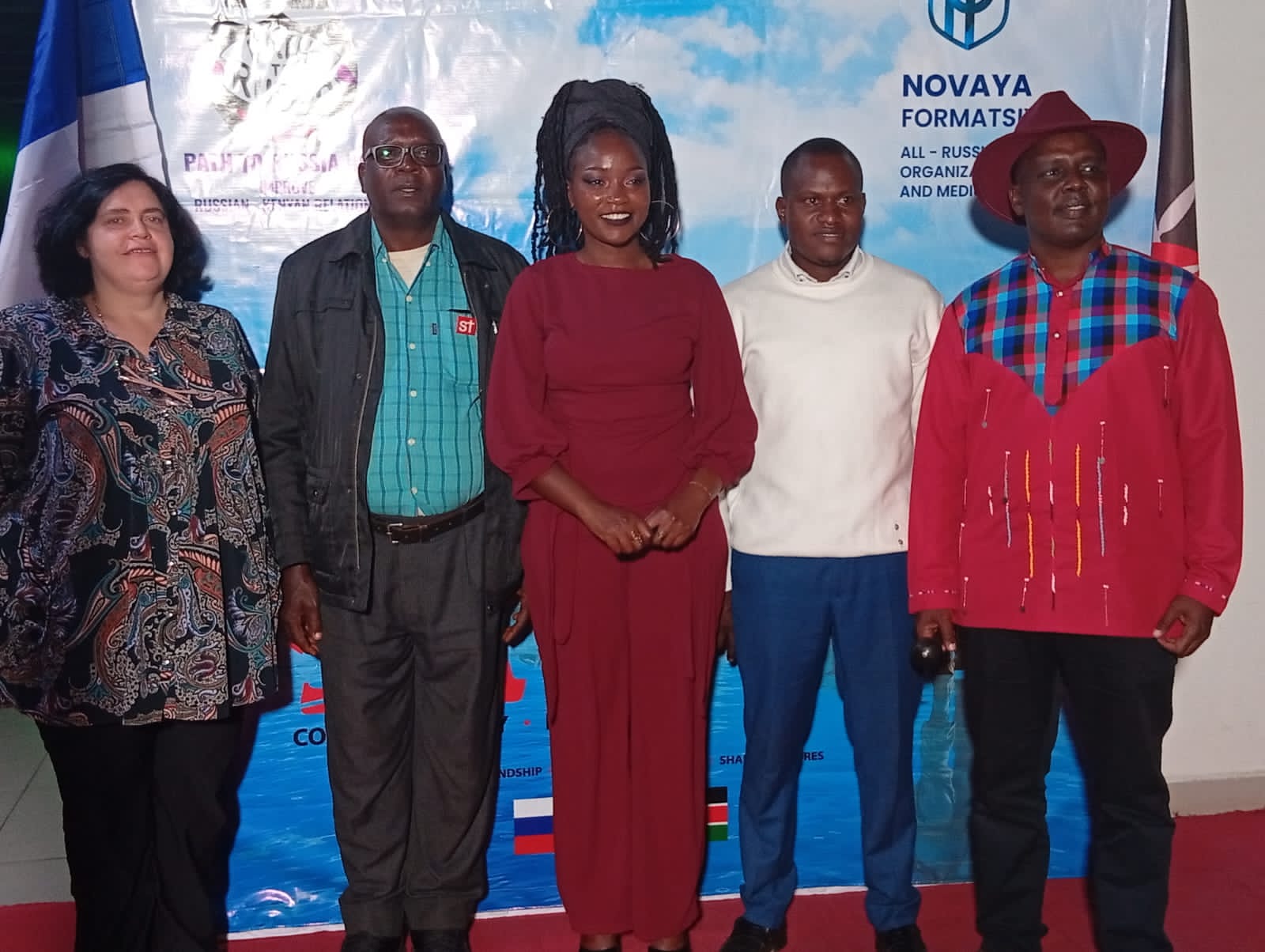
What began as a film screening turned into a celebration of culture, friendship and new possibilities as Kenya hosted the premiere of the Russian film Mission Sky at Greenspan Mall in Nairobi.
More than 100 guests from the Kenyan and Russian communities gathered for the event, which brought together government representatives, creatives, film lovers and cultural enthusiasts in what organizers described as a significant step towards strengthening ties between the two countries.
For many of those in attendance, the evening was not simply about watching a movie. It was about discovering another culture, challenging stereotypes and opening doors for future cooperation.
Among those attending was Paul Tobiko, an official from the Bido County Department of Education in the Governor’s Office, who said his own experience in Russia had taught him the importance of personal interaction in understanding other cultures.
Tobiko visited Moscow last year during the Russia-Africa Tourism and Investment Forum, where he participated as a speaker.
He said the experience changed some of his perceptions of Russia.
“What we probably knew all along is what we see in the headlines, what we see in the newspapers, in the news,” Tobiko said. “But I was amazed at how, by interacting with people, you get to appreciate more about their culture and all that.”
For him, Mission Sky offers Kenyans another window into Russian society.
He believes film can achieve what conventional communication sometimes cannot — allowing people to experience another culture through stories, characters and human experiences.
“Movies are ways of telling stories, ways of understanding people better,” he said.
The premiere also highlighted the enormous potential of Kenya’s creative industry.
Tobiko said Kenya has talented filmmakers and content creators who could benefit from greater international exposure and collaboration with Russian counterparts.
The hope is that cultural exchange will not remain a one-way journey.
Instead, Russian audiences could discover Kenyan stories while Kenyans explore Russian cinema, history and culture.
Eric Ochieng, coordinator of Path to Russia, the NGO behind the event, said this is precisely the vision behind the initiative.
He described Mission Sky as a powerful story of resilience, courage and determination, centred on a Russian pilot who faces serious challenges during a mission and manages to overcome them.
Ochieng said bringing the film to Kenya was intended to give local audiences a taste of Russian cinema while creating a foundation for long-term cooperation.
“This is the beginning of it. Actually, this is the first Russian film to be premiered in Kenya,” he said.
With more than 100 people attending, the premiere brought together people of different ages, professions and backgrounds.
Ochieng said the response demonstrated that there is an appetite among Kenyans for international cultural experiences.
He revealed that another Russian film screening is expected in the coming months, with plans already underway for continued cooperation with Russian producers.
The partnership is also expected to facilitate the distribution of Russian films in Kenya while opening opportunities for Kenyan content to reach Russian audiences.
According to Ochieng, Kenya’s young content creators are increasingly gaining international attention, making the country an attractive partner for foreign creative industries.
He described Kenya as a “hotbed for content creation” and said the partnership could help connect Kenyan talent with international opportunities.
For Tatiana Magarshak, the event carried a deeply personal meaning.
A Russian national who has lived in Kenya for more than 30 years, Magarshak said she considers Kenya her home while maintaining a strong emotional connection with Russia.
She said she was particularly excited about the opportunities the initiative could create for young Kenyans.
According to Magarshak, young people should be encouraged to explore international knowledge, technology, history and cinema without feeling limited by geographical boundaries.
She also spoke passionately about the legacy of her late Kenyan husband, who was involved in promoting Russian-African relations.
She said plans are underway to establish a foundation in his name to support education and knowledge-sharing and to encourage young Kenyans to compete confidently on the global stage.
Magarshak believes cultural exchange should work both ways.
She said Russians often associate Kenya with the Maasai Mara, wildlife and beaches, but there is much more to the country.
Kenya’s diverse communities, food, traditions, landscapes and lifestyles, she argued, deserve greater exposure to Russian audiences.
She encouraged the production and screening of more Kenyan films in Russia so that Russians can discover the country beyond the familiar tourism images.
In the same way, she wants Kenyans to discover Russia beyond what they may have seen in the news.
The future of filmmaking was also part of the conversation, particularly the growing influence of artificial intelligence.
Tobiko acknowledged that AI could make production faster and give filmmakers access to more information, but he maintained that human creativity remains at the heart of storytelling.
Magarshak agreed that AI has enormous potential but warned that technology must be accompanied by human judgment.
She said information generated by AI should be carefully checked because relying on technology without verification could result in serious mistakes.
And when it comes to emotions and relationships, she believes humans still have something technology cannot replicate.
“AI has nothing to do with love and feelings,” she said, emphasizing the continuing importance of human connection.
The Mission Sky premiere may have lasted only one evening, but organizers believe its impact could stretch much further.
The initiative is expected to pave the way for additional film screenings, educational exchanges, creative partnerships and greater interaction between Kenyan and Russian communities.
For young filmmakers, it could mean access to new ideas and international markets.
For audiences, it could mean discovering stories they might otherwise never encounter.
And for Kenya and Russia, it could mean building stronger relations through something universal: the power of a good story.
As the lights dimmed and Mission Sky began to roll, the audience was not merely watching a Russian film.
They were witnessing the opening scene of what organizers hope will become a much bigger story, a story of two cultures meeting, learning from one another and discovering new possibilities through film.