The Kenya Association of Stockbrokers and Investment Banks (KASIB) has endorsed the government’s proposal to partially divest its shareholding in telco giant Safaricom PLC, terming the move a strategic opportunity to raise capital while strengthening Kenya’s capital markets.
KASIB, when appearing before the National Assembly’s joint committee on Finance, National Planning, Public Debt and Privatisation, expressed support for Sessional Paper No. 3 of 2025.
The association stated that the transaction could generate approximately Sh244.5 billion in immediate revenue to support infrastructure development, debt reduction, and other national priorities.
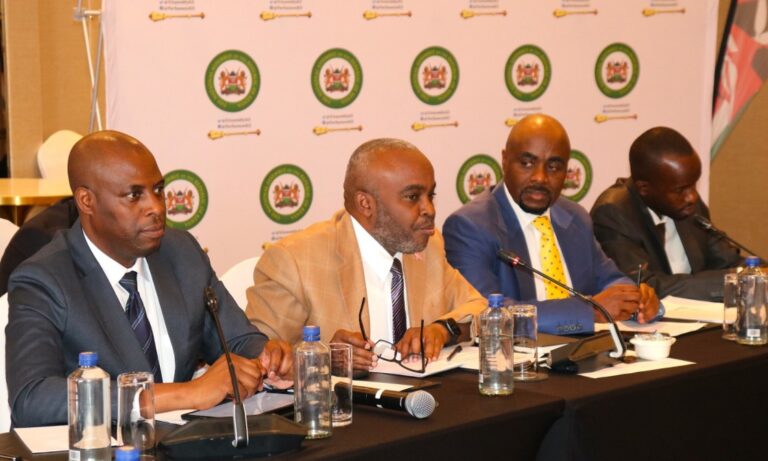
Willie Njoroge, Chief Executive Officer, Kenya Association of Stockbrokers and Investment Banks (KASIB), appearing alongside Fred Mburu, Chief Executive Officer, Fund Managers Association (FMA), backed the plan in a joint submission.
“KASIB supports the government’s decision to divest from Safaricom PLC as a strategic move to raise capital while maintaining meaningful oversight of this critical national asset,” the statement reads.
“We propose modifications to the transaction structure to maximize public benefit, enhance capital market development, and ensure market-wide participation in Kenya’s economic growth.”
KASIB proposed adjustments to the transaction structure to increase public participation and deepen market activity, recommending that the government increase the divestiture to 20 percent, with an additional five percent offered to the Kenyan public through the Nairobi Securities Exchange (NSE).
“We support both the divestiture decision and the proposed valuation, execution through the NSE Block Trading Board, increasing the total divestiture to 20 percent of government shareholding with the additional 5% offered to the public through the Nairobi Securities Exchange. We request acceleration of other planned privatisations and IPOs,” Njoroge said.
According to KASIB, the additional public offering could raise approximately Sh68 billion, bringing the total proceeds from the divestiture to around Sh312 billion.
Under the current proposal, Vodacom would acquire a 55% stake in Safaricom, the government would retain 15%, and the public shareholding would increase to 30%.
“The new shareholding structure would therefore be: Vodacom would acquire 55 percent as proposed, the government would retain 15 percent after divesting a total of 20 percent, and the public shareholding would increase to 30 percent through an additional 5 percent public offering,” Njoroge noted.
KASIB also supported the use of the NSE Block Trading Board to execute the transaction, arguing that the platform provides a transparent and regulated mechanism for large-scale share sales without disrupting normal market trading.
“The Block Board provides a regulated, transparent, and orderly mechanism for executing large-scale transactions in listed securities without disrupting normal market trading. Given Safaricom’s systemic importance to Kenya’s capital markets, exchange-based execution is critical to preserving price integrity, investor confidence, and market stability,” Njoroge told the lawmakers.
He argued that if the divestiture is approved, the government should retain the veto powers on any merger.
”We recommend the government retain veto rights on any merger or acquisition of the company. The new majority shareholder should be encouraged to maintain minimum capital investment levels, maintain employment levels, continue support for social impact programmes such as M-PESA Foundation and Safaricom Foundation, and retain headquarters and key operations in Kenya. The agreement should include sunset clauses allowing the government to buy back shares if conditions are breached and provide the first right of refusal if Vodacom seeks to sell its stake,” Njoroge advised.
KASIB also called on Vodacom to commit to maintaining Safaricom’s listing on the NSE and to refrain from any compulsory acquisition of minority shareholders, warning that any delisting would undermine investor confidence and capital market development.
“This commitment is essential to protect the rights of public investors and ensure continued market participation in Kenya’s most valuable listed asset,” Njoroge warned.
MP Peter Kaluma (Homa Bay Town), arguing on company laws regarding majority and minority shareholdings, questioned the regulatory framework, stating that if Vodacom acquires the majority shares of 55 percent, it will undoubtedly have the majority say.