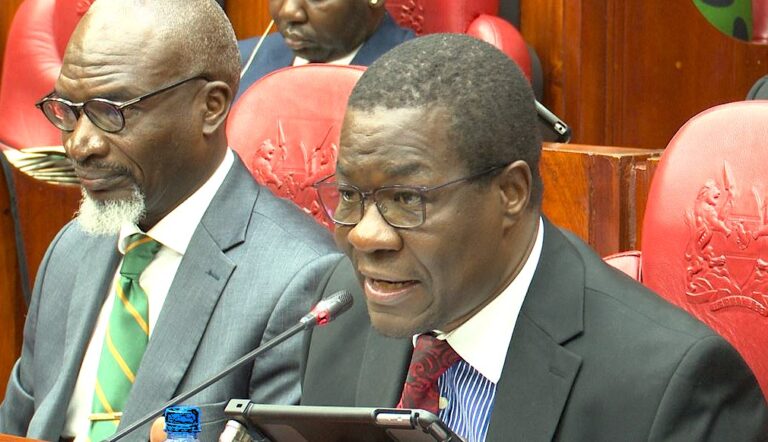
The government has defended the proposed South Lokichar oil development project in a presentation to the joint committee of the Senate’s Committee on Energy and the National Assembly’s Committee on Energy.
Appearing before lawmakers, Opiyo Wandayi, the Cabinet Secretary for Energy and Petroleum, cited legal compliance and environmental safeguards as the basis for seeking parliamentary approval for the Field Development Plan (FDP) and Production Sharing Contracts (PSCs) covering Blocks T6 and T7.
Wandayi outlined the rationale behind the approval of the South Lokichar Field Development Plan.
The South Lokichar Basin, where oil was first discovered in 2012, has recorded ten discoveries to date, with four fields Ngamia, Ekales, Amosing, and Twiga classified as the most mature.
With the overarching goal of optimising the value of Kenya’s petroleum resources, the South Lokichar development is strategically significant. Prior attempts to secure a strategic partner for the development of the project have not been successful due to the marginal resource size. The project requires fiscal support to attract the required capital for its realisation,” said Wandayi.
Government estimates place the Stock Tank Oil Initially in Place at 2.85 billion barrels, with recoverable resources projected at 429 million barrels over the field’s life.
According to Wandayi, “raising the cost recovery limit from 55 percent for Block T6 and 65 percent for Block T7 to 85 percent will improve Kenya’s competitiveness, improve bankability, and attract capital to advance the South Lokichar Project towards development and production, thus delivering the desired national economic benefits.”
According to the Cabinet Secretary, the decision to pursue a joint development of Blocks T6 and T7 was driven by economic realities, noting that the individual fields are marginal and would not be viable as standalone projects, saying the joint approach allows for shared infrastructure, including a single Central Processing Facility, in line with international best practice.
“On the other hand, maintaining the cost recovery limit at 55 percent and 65 percent for blocks T6 and T7, respectively, would mean an extended cost recovery period and present difficulty in accessing debt finance. This would mean a longer recovery period that will attract higher interest rates, which will eventually be passed on to Cost Oil,’’ Wandayi affirmed to the legislators.
Narok Senator Ledama Ole Kina raised concerns over debt transparency and cost overruns dominating the parliamentary scrutiny of the South Lokichar oil project, demanding clearer safeguards from the developer.
“There was a need for a detailed structure of the debt to be honoured, and we would like to get a confirmation that if the field development goes above the budget, the developer will cushion it. It was important for them to be open in how they run the activities,” Ledama said.
Tana River Senator Danson Mungatana said political pressure has mounted on Turkana leaders over the project’s management, revealing that Turkana Senator James Lomenen’s repeated requests for oil accountability reports have not been met.
On fiscal matters, the government defended the proposed increase of the cost recovery ceiling to 85 percent for both blocks, up from 55 percent and 65 percent, respectively.
”Comparative analysis of other jurisdictions shows that cost recovery ceilings range from 70 percent (Niger, Senegal) to 85 percent (Angola, Cameroon) and 100 percent (Ghana). This shows that the recovery limit of 85 percent is consistent with industry practice,’’ Wandayi said.
Wandayi told legislators that the adjustment is necessary to improve the project’s bankability and attract debt financing, particularly as global capital shifts away from hydrocarbons.
Revenue from the project will accrue to the national government, county governments, and local communities through profit oil, where the additional income is expected from tariffs, land leases, water supply, power sales, storage, and transport services.
The CS said, ‘‘The Government will receive direct revenues from the project through its share of the project’s profit oil as per clause 27(3) of the PSCs and the annual split of revenue share between the National Government, the County Government, and the Local Community,’’ adding that the Government elects to participate in the project, the Government will also, through its nominee, receive a share of the contractor’s Profit Oil equivalent to its participation interest which is twenty percent.’’
On environmental safeguards, Wandayi assured Parliament that the project has met regulatory requirements, including approval of an environmental and social impact assessment by the National Environment Management Authority (NEMA).