
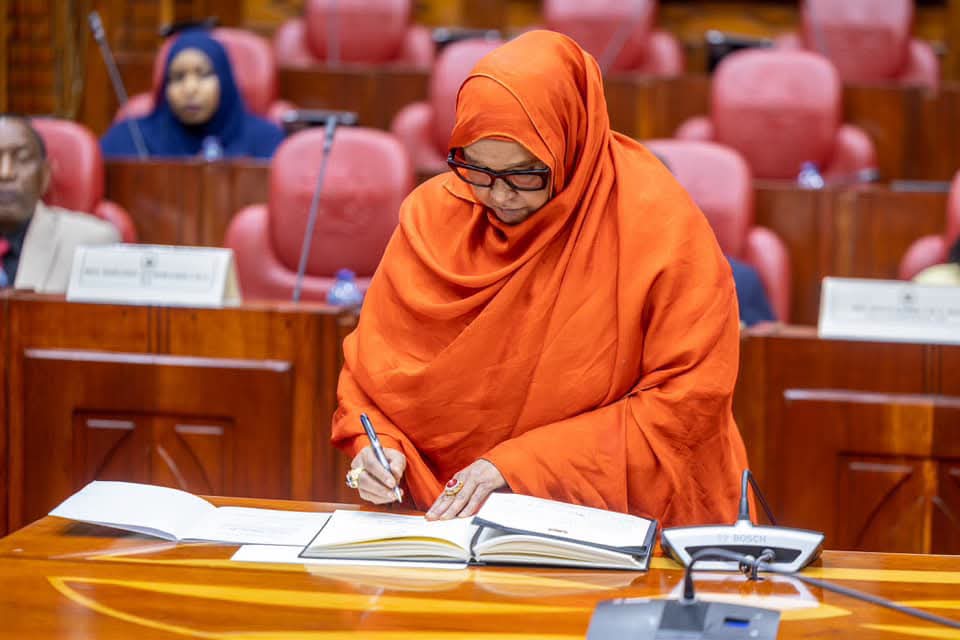
Former Wajir County Woman Representative Fatuma Ibrahim Ali was sworn in Thursday as the newest female non-Member Commissioner of the Parliamentary Service Commission, pledging to promote consensus, integrity and teamwork in the management of Parliament’s affairs.
Ms. Fatuma replaces former commissioner Rachel Ameso, whose term in office ended recently. Her appointment followed a competitive recruitment process in which the Parliamentary Service Commission interviewed 12 shortlisted candidates on Sept. 10.
She emerged as the highest-ranked candidate after being assessed on her academic qualifications, experience in public affairs, understanding of the mandate of Parliament and the commission, leadership and management skills, and compliance with the leadership and integrity requirements under Chapter Six of the Constitution.
The Senate approved her appointment on Oct. 1, while the National Assembly endorsed her nomination on Wednesday.
Speaking after taking the oath of office, Ms. Fatuma said she was humbled by the opportunity to serve and pledged to work with fellow commissioners to protect the commission’s constitutional mandate.
“I am a person who believes in consensus in commissions. Consensus is very crucial in decision-making, and I am committed to working on consensus at all times,” she said.
She said consensus would be essential in keeping the commission focused on its mandate and protecting the interests of Parliament.
Ms. Fatuma thanked Parliament, the commission’s leadership, her political party and those who supported her appointment. She also recalled her previous association with National Assembly Speaker and PSC chairman Moses Wetang’ula, saying they had worked together during her time in Parliament and during her bid to join the East African Legislative Assembly.
Ms. Fatuma served as the Wajir County Woman Representative and was a member of the 11th Parliament.
Welcoming her to the commission, Mr. Wetang’ula said Ms. Fatuma’s experience in public service would strengthen the institution at a time when Parliament was seeking to improve its effectiveness, uphold integrity and deepen public understanding of its work.
“You have been in this Parliament with us. You have a rich history behind you and I have no doubt whatsoever that you will add value to this Commission,” said Mr Wetang’ula.
The Speaker urged the new commissioner to be a team player and place the interests of Parliament, its members, staff and the institution of democracy above personal, sectarian or regional interests.
He also praised Ms. Ameso, whom Ms. Fatuma replaced, saying she had left an “indelible mark” during her tenure.
Mr. Wetang’ula said consensus had become the preferred method of decision-making within the commission, noting that commissioners had never voted on an issue.
“We have never voted on any issue, and we are unlikely to vote on any issue. If we don’t agree, we sleep over it and come the next day,” he said.
He said the approach had helped the commission remain united and avoid divisions that could emerge from voting.
Nyandarua Woman Representative Faith Gitau, who said she had known Ms. Fatuma for more than a decade, welcomed her to the commission and praised her commitment to public service.
“It’s a heart to serve, and I know you have the brains for this job,” she said.
PSC Commissioner Johnson Muthama also welcomed Ms. Fatuma, saying her record in public service had prepared her for the demanding responsibilities ahead.
“We are non-elected commissioners, so a lot is expected from us. One thing I can assure you is that the commissioners have great support and the leadership of the chairman,” he said.
Mavoko MP Patrick Makau, who said he had worked with Ms. Fatuma during the 11th Parliament, described her appointment as an opportunity to continue serving the country and assured her of a supportive environment as she settled into the commission.
Likoni MP Mishi Mboko said she had known Ms. Fatuma for more than 20 years through ODM party structures and Parliament.
Ms. Mboko said the new commissioner had demonstrated integrity and experience in public service and would bring valuable expertise to the commission.
“She is a team player, so it will not be difficult for her to be in the spirit which we have here in this Commission,” Hon. Mboko said.
Nyeri Senator Wahome Wamatinga also welcomed Ms. Fatuma, saying her previous working relationships with several commissioners would make it easier for her to settle into the commission.
He said her experience would be useful in the committees she would serve on and encouraged her to share her knowledge with colleagues, particularly as the country approaches the next General Election.
Nyamira Senator Okong’o Omogeni, who represented the PSC during the parliamentary approval process, congratulated Ms. Fatuma on behalf of the Senate.
Senator Omogeni said her top ranking in the recruitment process reflected her record and experience in public affairs. He described her appointment as both a privilege and a responsibility because the commission serves Parliament and its members.
PSC Vice-Chairperson and Nominated Senator Joyce Korir also congratulated Ms. Fatuma, wishing her wisdom, integrity and courage during her tenure.
Senator Korir said she had known Ms. Fatuma for about a decade and expressed confidence that she would make a positive contribution to the commission.
She also urged Ms. Fatuma to build on the work of Ms. Ameso, whom she described as a gracious commissioner who had made a significant contribution to the PSC.
The Parliamentary Service Commission is established under Article 127 of the Constitution and is responsible for providing services and facilities necessary for the efficient and effective functioning of Parliament.
The commission also establishes offices in the Parliamentary Service, appoints and supervises office holders, prepares annual expenditure estimates, exercises budgetary control over the Parliamentary Service and undertakes programmes to promote the ideals of parliamentary democracy.
It is also mandated to perform functions necessary for the welfare of members of Parliament and parliamentary staff.
Mr. Wetang’ula urged Ms. Fatuma to draw on her experience to strengthen the commission and help Parliament deliver on its core functions of representation, legislation and oversight.
He also challenged the commissioners to continue engaging with the public through outreach programmes, saying Kenyans should have a better understanding of Parliament’s work and role.
The Speaker said the commission would continue working to improve Parliament and strengthen public confidence in the institution.
“By building consensus, you carry everybody. When you vote, you split yourselves. So we want to build consensus and hold this Parliament together,” Speaker Wetang’ula held.