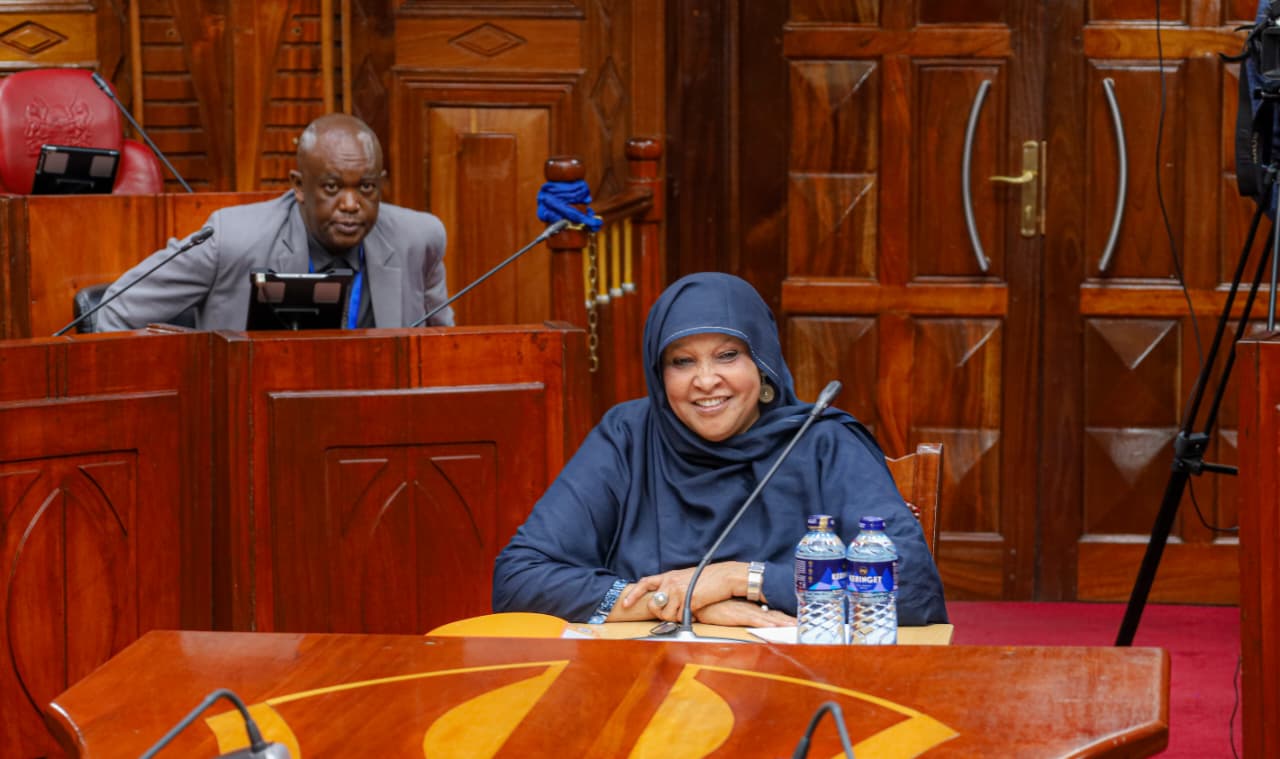
Parliamentary Service Commission (PSC) commissioner nominee Fatuma Ibrahim Ali has pledged to prioritise staff welfare, promote equal opportunities and strengthen parliamentary operations, citing her experience in government and parliamentary committees as key assets she would bring to the commission.
Appearing before the Senate Committee on Justice, Legal Affairs and Human Rights, chaired by Bomet Senator Hillary Sigei, Fatuma outlined her priorities, including fair staff management, improved public engagement and equitable treatment of both Houses of Parliament.
Her vetting followed an earlier process conducted by a commission led by National Assembly Speaker Moses Wetang’ula, which forwarded her name to the Senate for further consideration. The Senate committee is expected to submit its report before the full House.
Defending her suitability for the position, Fatuma said her experience in government and parliamentary committees had given her a clear understanding of Parliament’s operations and the responsibilities of the commission.
“I have confidence, I understand what it entails. I’m one person who has worked in government and I understand parliamentary rules, the work and needs of parliament,” she told senators.
She added, “I have worked in parliamentary committees and I want to confirm that I have a good start, a clear understanding of the whole processes.”
Responding to Kisumu Senator Tom Ojienda, who sought to establish her understanding of the commission’s mandate, Fatuma said she would focus on providing facilities for parliamentary staff and legislators while supporting staff training, recruitment and promotion.
“I will provide facilities for the staff and Parliament to effectively work and I will help the commission in terms of training, promotion and recruitment of the staff. I will help in education dissemination to the public,” she said.
She also pledged to promote effective communication, strengthen institutional capacity and ensure that parliamentary services remained accessible to the public.
On human resource management, Fatuma highlighted the need for transparency and thorough scrutiny of decisions affecting employees, particularly staff layoffs. She said she would seek to ensure that such decisions were properly examined before implementation.
“Large focus as a commissioner is to effectively add my voice to the commission and key is that of staff lay offs where I will help to clear just from the word go where we shall do thorough scrutiny of documents before going to the crucial stages.”
She further pledged to support fair recruitment and career development, saying employees from different backgrounds should have equal opportunities within the parliamentary service.
“I will help in adding more skills to human resource teams to consider all groups they get equal opportunity in the establishments.”
Addressing concerns about workplace discrimination, the nominee said she would advocate for mechanisms to ensure fairness and promote respectful working relationships among parliamentary employees.
“I’m very keen on discrimination, I will not allow that to happen as I will bring up mechanisms to curb that menace and we fairly treat each other in the service.”
Fatuma also emphasised the importance of bringing parliamentary activities closer to citizens through initiatives such as Senate Mashinani. She said she would support efforts to extend public engagement to sub-counties, allowing more Kenyans to participate in governance and devolution discussions.
On relations between the two Houses of Parliament, she pledged to ensure that both the National Assembly and the Senate received fair consideration in the commission’s activities.
“I will be very careful that both houses are given a fair share in all the activities and any conflict arises and I will have to engage the commission on the same.”
Makueni Senator Dan Maanzo questioned how she would handle potential conflicts involving members from her region if such disputes were brought before her as a commissioner.
“If it arises that there are conflicts from your region by members what will you do to ensure there is peace if the issue is raised before your desk,” Maanzo asked.
Committee chairman Sigei cautioned Fatuma against allowing regional or community interests to influence her responsibilities, emphasising that she would be serving the country rather than a particular community.
In response, Fatuma assured the committee that she would discharge her duties with sensitivity and remain guided by the commission’s mandate.
“I will be very sensitive in delivering the mandate.”
The committee also examined her academic qualifications, with Busia Senator Okiya Omtatah seeking clarification on her postgraduate studies and the recognition of her degree.
Fatuma explained that she had undertaken postgraduate studies in the United Kingdom after being advised that the qualification would be treated as equivalent to a degree. She subsequently pursued a master’s degree and said the relevant higher education authorities had confirmed the equivalence of her qualifications.
“I did my degree in UK where I was advised to do a postgraduate to be treated as the degree. The University in UK, did my postgraduate as a degree and immediately I did my masters. The higher education has confirmed the same regarding my two diplomas were combined and did my postgraduate and it was confirmed as the Degree certificate.”
During the vetting, Fatuma also disclosed that her net worth was Sh302 million as senators examined her personal and professional background.
Her presentation centred on staff welfare, institutional accountability, equal opportunities and public participation, which she identified as key areas of focus should she be appointed.
The committee’s report will provide the basis for the Senate’s consideration of her nomination, paving the way for the House to determine the next stage of the appointment process.